 EN
EN
 NL
NL PL
PL 

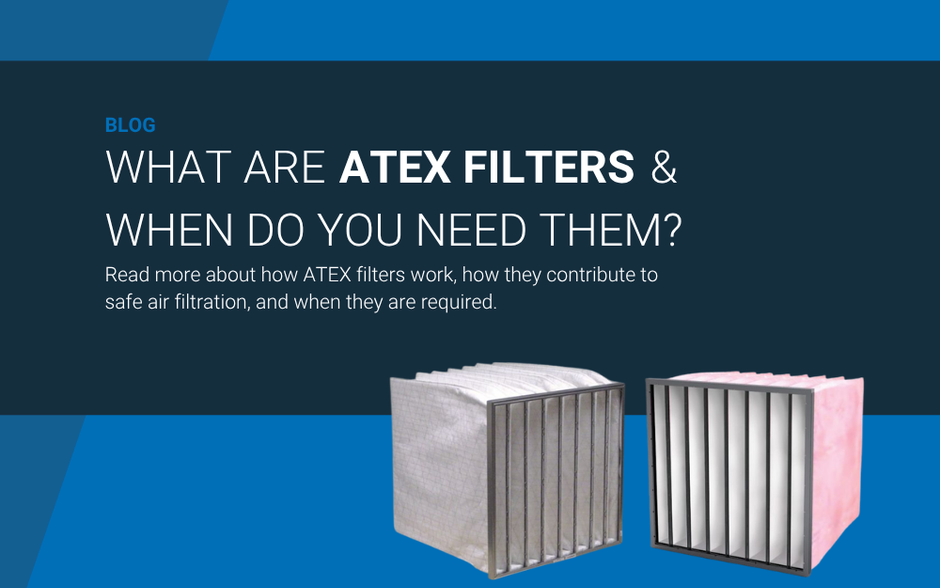
In industrial environments where flammable gases, vapors or dust particles are present, an explosive atmosphere can occur. In these situations, specific safety guidelines apply to equipment and installations. This also applies to air filtration.
ATEX filters are specifically developed for use in these explosion-sensitive environments. But what exactly are ATEX filters and when should you choose an ATEX filter within your installation? In this blog, we explain what ATEX means, the role ATEX filters play in a safe industrial environment and why this is important.
What does ATEX mean?
ATEX is a European directive for equipment and protective systems used in explosive atmospheres. The name is derived from the French term: ‘ATmosphères EXplosibles’.
Within the ATEX directive, work areas are classified into different zones. These zones indicate the likelihood of an explosive atmosphere being present. A distinction is made between zones for gas or vapor and zones for dust.
For gas or vapor, the following zones are used:
- Zone 0: explosive atmosphere is present continuously or for long periods (more than 10% of operating time).
- Zone 1: explosive atmosphere may occur regularly (between 0.1% and 10% of operating time).
- Zone 2: explosive atmosphere is not likely to occur during normal operation but may occur occasionally (less than 0.1% of operating time).
Similar zones are used for combustible dust:
- Zone 20: explosive dust atmosphere is present continuously or for long periods (more than 10% of operating time).
- Zone 21: explosive dust atmosphere may occur regularly (between 0.1% and 10% of operating time).
- Zone 22: explosive dust atmosphere is not likely to occur during normal operation but may occur occasionally (less than 0.1% of operating time).
In these zones, all equipment must comply with the ATEX directive. This means that air filtration components must also be suitable for use in these explosion-sensitive environments.
What is an ATEX filter?
An ATEX filter is an air filter specifically designed for use in explosive atmospheres. The construction and filter media are developed to reduce the risk of static discharge or spark formation.
ATEX filters therefore often have antistatic properties. This allows accumulated electrostatic charge to be safely discharged.
Key characteristics of ATEX filters include:
- Synthetic filter media with conductive steel mesh, capable of discharging electrostatic charge.
- Progressively structured filter media, allowing dust to be retained gradually while maintaining stable pressure build-up.
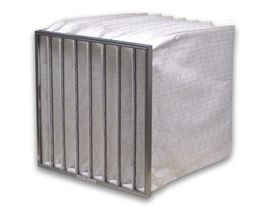
- Bag filter construction with a large filter surface, resulting in low air resistance and longer service life.
- Mechanically stable construction, for example with a steel frame and reinforced filter bags for use in industrial air handling systems.
These properties enable ATEX filters to be safely applied in industrial installations where explosion risks are present.
Why are ATEX filters important?
In many industrial processes, combustible dust particles are released. Examples include production processes in the food industry, chemical industry or metal processing.
When these dust particles accumulate or continue to circulate in the air, an explosive mixture can form. A single ignition source can then be sufficient to cause an explosion.
ATEX filters therefore play an important role in installations where explosion risks are present. By effectively removing dust particles from the air, ATEX filters contribute to the safe operation of air handling systems.
In addition, ATEX filters must prevent the build-up of electrostatic charge in the filter media. This is a key consideration within ATEX zones.
When should you choose ATEX filters?
ATEX filters are used in industrial environments where flammable gases, vapors or dust particles may be part of the process. This includes applications such as:
- Chemical industry
- Food industry
- Pharmaceutical production
- Metal processing
- Storage and handling of flammable substances
The selection of the right ATEX filters depends on various factors, such as zone classification, type of dust particles and the specifications of the air handling system.
Which ATEX filters does Interfilter offer?
Interfilter offers synthetic bag filters suitable for use in ATEX-classified environments. These filters combine efficient dust separation with properties that support safe operation in explosion-sensitive environments.
Our range includes synthetic bag filters type IFS EX, equipped with conductive synthetic filter media and applicable in ATEX zones 1, 2, 21 and 22. These filters are used for fine filtration in industrial air handling systems.
In addition, ATEX is an important consideration in dust collection systems with a very high dust load. In these more demanding industrial applications, dust collection filters play a key role in safely capturing dust particles within ATEX-classified environments.
Non-binding filter advice
For each installation, we carefully assess which filter best matches the application, process conditions and zone classification.
Do you need assistance in selecting the right ATEX filter? Please contact us. Interfilter supports you in selecting a suitable filtration solution.