 EN
 NL
 PL


Gas filters and odor filters
The operation of gas and odor filters
 For capturing odors and/or (harmful) gases, we supply various filter media. These are media shaped like of pellets or spherically shaped, depending on the type of medium. These types of filters are also called molecular filters. The molecules are either chemically bound within the filter medium (absorption), or adsorbed in the medium without binding and can be released again after saturation (adsorption). This also depends on the type of medium. In this document you can read more about the different types of carbon and adsorption capacity.
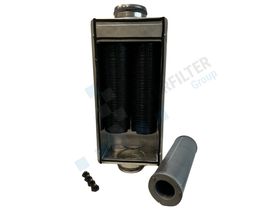
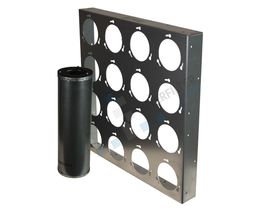
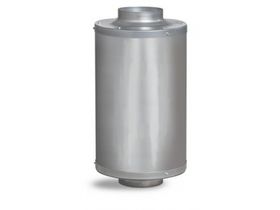


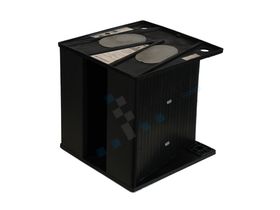



Assortment of gas and odor filter media

The media we have included in our assortment are made from either impregnated activated carbon types, impregnated zeolite or activated and impregnated aluminum oxide.
The medium to be used depends on various factors, such as the concentration of contamination to be captured, the temperature of the airflow, and the type of contamination.
Contact us for more information about the type of filter to be used.
Filter housing of gas and odor filters
We supply various housings that can be filled with one or more types of filter media. The contaminated airflow is then passed through the filter medium. Examples of housings are steel or plastic perforated cans that are attached to a base plate using a bayonet closure, plastic modules in V-shape or deep bed filter drums. The latter are particularly suitable for large airflows with high contamination. If desired, we also supply the media in bulk packaging.

Free advice on gas and odor filtration
Below is an overview of our range of molecular filters. For specific applications or a free advice or quotation, you can contact us.
Frequently asked questions
Contact time is the time during which the contaminated air is in contact with the activated carbon or another molecular filter medium. This time is influenced by the amount of filter medium and the speed at which the air flows through it. When selecting a gas and odor filter, it is therefore important to look not only at the type of carbon, but also at the airflow and the amount of filter medium, in order to achieve an optimal contact time. If the contact time is too short, the efficiency of the filter will decrease. The required version depends on the contaminant and the application.
Standard activated carbon is suitable for various gaseous and odorous contaminants. For certain substances, a specially treated, impregnated activated carbon may be needed to capture them more effectively. The right medium therefore depends on the specific substance that needs to be removed from the air. Interfilter supplies various types of activated carbon and other molecular filter media and can advise which version suits your application.
The conditions of the airflow affect the performance of gas and odor filtration. Both temperature and relative humidity must fall within the specifications of the filter medium used. Under different conditions, another type of activated carbon or molecular filter medium may be required. That is why you should always provide information about the temperature, humidity and contaminants present when selecting a filter.
Activated carbon is used to remove gaseous contaminants and odors from an airflow. The molecules adhere to the large internal surface area of the activated carbon. However, not every contaminant is captured equally well by the same type of carbon. That is why, in addition to standard activated carbon, impregnated carbons and other molecular filter media are also available. Interfilter can advise which medium is suitable based on the contaminant present.
Activated carbon has a limited capacity to absorb gaseous contaminants. How quickly the medium becomes saturated depends on the type of gas, the concentration and the airflow conditions. As a result, there is no single fixed replacement interval for all activated carbon filters. If the application is critical, the replacement moment must be matched to the load and operating conditions. Interfilter can advise on this.
With a standard particle filter, accumulated contamination usually causes the air resistance to increase. Activated carbon works differently. Gaseous molecules are adsorbed into the filter medium and gradually fill the available adsorption capacity. As a result, the activated carbon can become saturated while the pressure drop barely changes. Looking at the resistance alone is therefore not enough to determine the remaining capacity.


