 EN
EN
 NL
NL PL
PL 

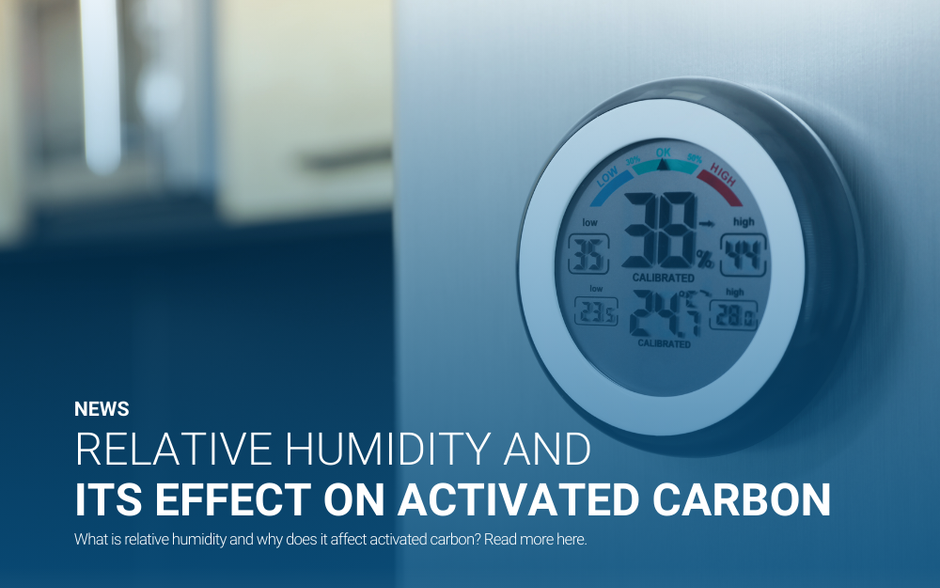
Relative humidity and temperature play an important role in the performance of activated carbon filters.
These environmental factors influence adsorption capacity and therefore the effectiveness of odour and gas removal. In this article, we explain how relative humidity and temperature affect the performance of activated carbon and what to consider in practice.
What is relative humidity?
Air can always contain a certain amount of water vapour. The maximum amount of water vapour air can hold depends on temperature and air pressure.
Relative humidity (RH) indicates how much moisture the air actually contains compared to the maximum possible amount at the prevailing temperature and air pressure. It is expressed as a percentage and calculated as:
Relative humidity = (actual moisture content / saturation moisture content) × 100%
Or: RH = (AM / SM) × 100%
As temperature increases, air can hold more water vapour. If the absolute amount of moisture remains the same,  relative humidity will decrease as temperature rises.
Indoor environments typically have a relative humidity between 40 and 60 percent. Outdoors, RH varies widely and depends on weather conditions and air pressure. At an RH above 100 percent, water vapour condenses in the form of dew, fog or frost.
Influence of relative humidity on activated carbon
Activated carbon is capable of adsorbing a wide range of gases and odours. In addition to these substances, water molecules are also adsorbed by the carbon surface.
At high relative humidity, typically above 50 to 70 percent, water molecules increasingly occupy active adsorption sites within the carbon structure. As a result, less capacity remains available for capturing other gaseous contaminants.
This leads to a reduction in adsorption efficiency for gases and odours. Relative humidity is therefore a key factor when selecting and applying activated carbon filters.
Influence of temperature on the performance of activated carbon
The operation of activated carbon is based on Van der Waals forces. These are the attractive forces between the carbon atoms and the molecules of the gases to be removed.
Temperature affects the speed at which gas molecules move. As temperature increases, the kinetic energy of the molecules rises and they move faster. This shortens the contact time between the gas molecule and the carbon surface.
Above a certain temperature, this contact time becomes insufficient for effective adsorption. The molecules can no longer bind properly to the carbon.
For standard activated carbon, the ideal air temperature generally lies between 15 and 50°C. At temperatures above approximately 80°C, adsorption efficiency decreases significantly.
What are the practical considerations?
When using activated carbon, it is important to take both temperature and relative humidity into account. These parameters largely determine the service life and effectiveness of the filter.
Interfilter supports you in selecting the right carbon grade and filter solution, tailored to your specific process conditions.
Would you like to know which solution best fits your application? Please contact one of our specialists.